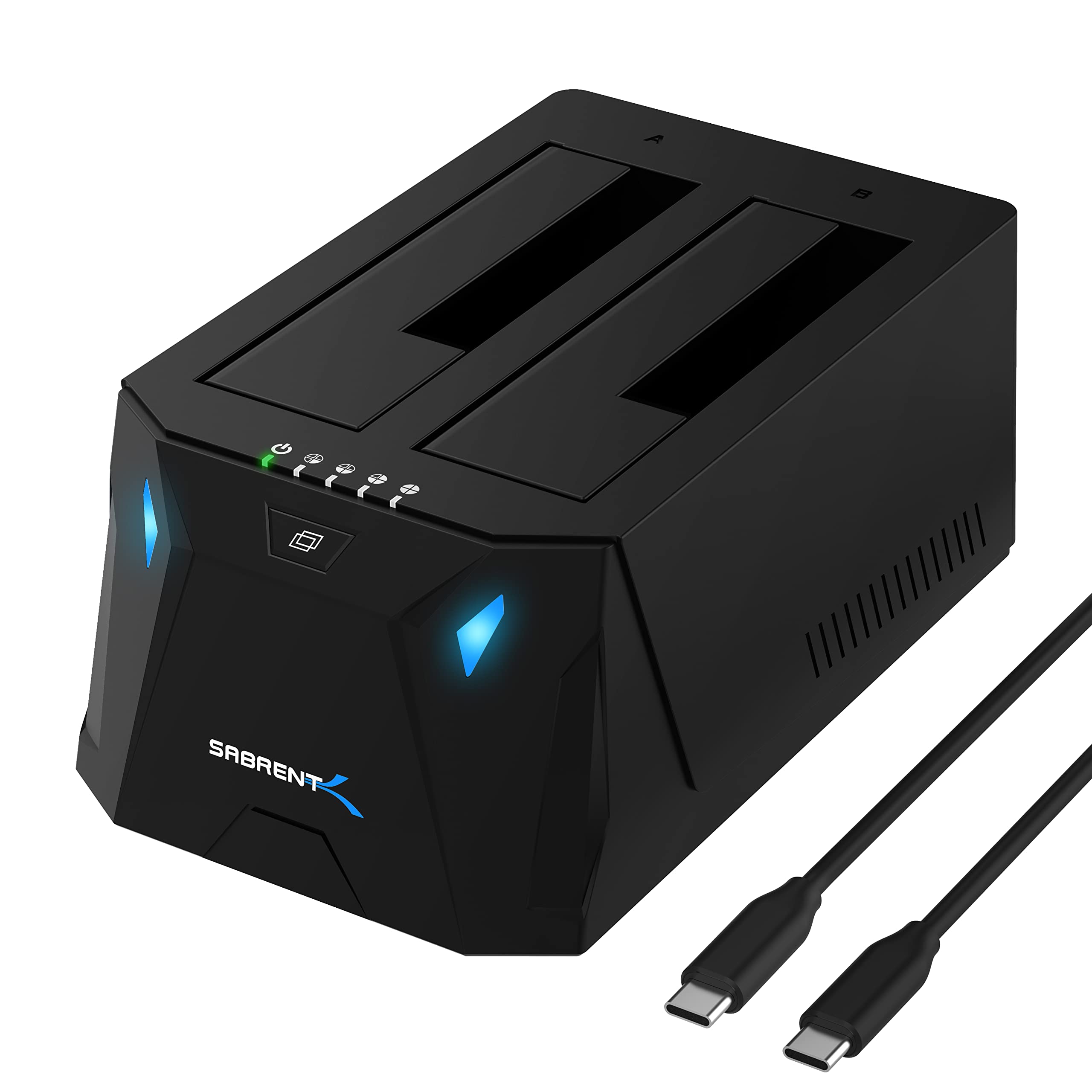
The SABRENT Dual-Bay USB-C Hard Drive Docking Station & Cloner review is for anyone who regularly works with loose SATA drives and wants one dock for access and offline copying.
Its two-bay layout supports 2.5- and 3.5-inch SATA HDDs, with USB-C connectivity and a computer-free clone function.
SABRENT Dual-Bay Dock Review Summary
The quick verdict
1,000+ ratings
Read Amazon ReviewsSABRENT Dual-Bay USB-C Hard Drive Docking Station & Cloner
A practical fit for buyers who want to access two SATA drives at once or clone between them without a computer.
- Dual-bay design supports reading and writing two hard drives simultaneously when connected to a computer.
- Offline cloning copies directly between drives without requiring a computer; the listed cloning rate is up to 60MBps.
- Compatible with 2.5- and 3.5-inch SATA HDDs.
- USB 3.0 connection supports transfer speeds up to 5Gbps.

Pros
- Combines simultaneous two-drive access with offline cloning in one dock.
- Accepts both 2.5- and 3.5-inch SATA HDDs.
Consider before buying
- The stated 5Gbps figure is a maximum interface speed, so it should not be treated as a promise of real-world throughput.
- The drive support described is for SATA HDDs; buyers with another drive interface should check compatibility before choosing it.
Read the full review summary
The main appeal is flexibility: insert two compatible drives, connect the dock to a computer to read and write both, or use offline cloning when you want to copy directly between drives.
Tool-free installation and hot swapping make it suitable for occasional drive recovery, transfers, and maintenance without fitting each drive into an enclosure.
This design is most relevant to people who already use 2.5- or 3.5-inch SATA HDDs and want a reusable desktop tool.
It is less compelling if your drives are a different format or you only need a single drive connected at a time.
The stated transfer ceiling is up to 5Gbps over USB 3.0; actual transfers depend on the drives and setup.
The buying factors
SABRENT Dual-Bay Dock Scorecard
Editorial scores reflect listed features and buyer fit; they are not laboratory measurements or customer ratings.
Drive format flexibility
Supports both 2.5- and 3.5-inch SATA HDDs, covering two common drive sizes.
Two-drive workflow
Can read and write two drives simultaneously when connected to a computer.
Offline cloning
Direct cloning works without a computer, with support listed up to 60MBps.
Setup convenience
Tool-free installation and hot swapping simplify routine drive access.
Connection speed ceiling
USB 3.0 transfer speeds are listed up to 5Gbps, a ceiling rather than a guaranteed drive speed.
Operating system coverage
Compatibility includes both Windows and Mac OS.
Key Features and Specifications of SABRENT Dual-Bay Dock
- Dual-bay design supports reading and writing two hard drives simultaneously when connected to a computer.
- Offline cloning copies directly between drives without requiring a computer; the listed cloning rate is up to 60MBps.
- Compatible with 2.5- and 3.5-inch SATA HDDs.
- USB 3.0 connection supports transfer speeds up to 5Gbps.
- Tool-free installation and hot-swappable operation support quick drive changes.
- HDD access LED indicator provides a visual activity cue.
- Works with Windows and Mac OS and supports drives described as 20TB or larger.
Pros and Cons of SABRENT Dual-Bay Dock
Pros
- Combines simultaneous two-drive access with offline cloning in one dock.
- Accepts both 2.5- and 3.5-inch SATA HDDs.
- Tool-free setup and hot swapping make drive changes straightforward.
- USB 3.0 speed ceiling and Windows/Mac compatibility suit a range of everyday transfer setups.
Consider before buying
- The stated 5Gbps figure is a maximum interface speed, so it should not be treated as a promise of real-world throughput.
- The drive support described is for SATA HDDs; buyers with another drive interface should check compatibility before choosing it.
- Offline cloning is listed up to 60MBps, so buyers planning large copies should account for a potentially lengthy transfer.
Who Should Buy SABRENT Dual-Bay Dock?
Good fit
Consider this dock if you often move files between loose 2.5- or 3.5-inch SATA HDDs, or want to connect two drives to a computer at once.
The simultaneous read/write function can make it useful for manual transfers, while the offline clone mode offers a separate direct-copy workflow when a computer is not part of the process.
It is also a sensible candidate for a home workbench or occasional maintenance kit. Hot swapping, tool-free installation, and an activity LED make repeated access less cumbersome than installing drives into a computer each time.
Before buying, match your drives to the stated SATA HDD support and consider the amount of data involved in cloning. The up-to figures describe ceilings; the source and destination drives will shape the actual transfer pace.
Who should skip it
Skip this model if you need a dock for NVMe, M.2, IDE, or another drive type rather than the listed 2.5- or 3.5-inch SATA HDDs.
If you only need to connect one drive occasionally, the second bay and cloning feature may add little value to your setup.
How the SABRENT Dual-Bay Dock fits a drive workflow
Two bays for access and copying
A two-bay dock is useful when a task involves both a source and a destination drive. This model can read and write two drives simultaneously through a computer, while offline cloning gives it a direct-copy role.
That makes the distinction between file-by-file computer transfers and drive-to-drive cloning an important part of deciding whether the extra bay suits your routine.
SATA size compatibility
Support for 2.5- and 3.5-inch SATA HDDs covers both compact laptop-style drives and larger desktop drives.
Buyers should identify the interface and physical format of their drives before choosing a dock; the stated compatibility does not establish support for other formats.
Speed expectations
USB 3.0 is listed at up to 5Gbps, while offline cloning is listed up to 60MBps. These are different parts of the workflow, and neither should be read as a guaranteed sustained rate.
Drive condition, capacity, and the specific task affect how long a transfer takes, so large clone jobs are best planned with time to spare.
Convenience during repeated use
Tool-free insertion, hot swapping, and an HDD access LED point toward a setup designed for changing drives rather than leaving them permanently installed.
That can help with occasional backups or diagnostics, provided drives are handled carefully and any active work has finished before removal.
Alternatives to SABRENT Dual-Bay Dock
Hard Drive Docking Stations alternative
17,000+ ratings
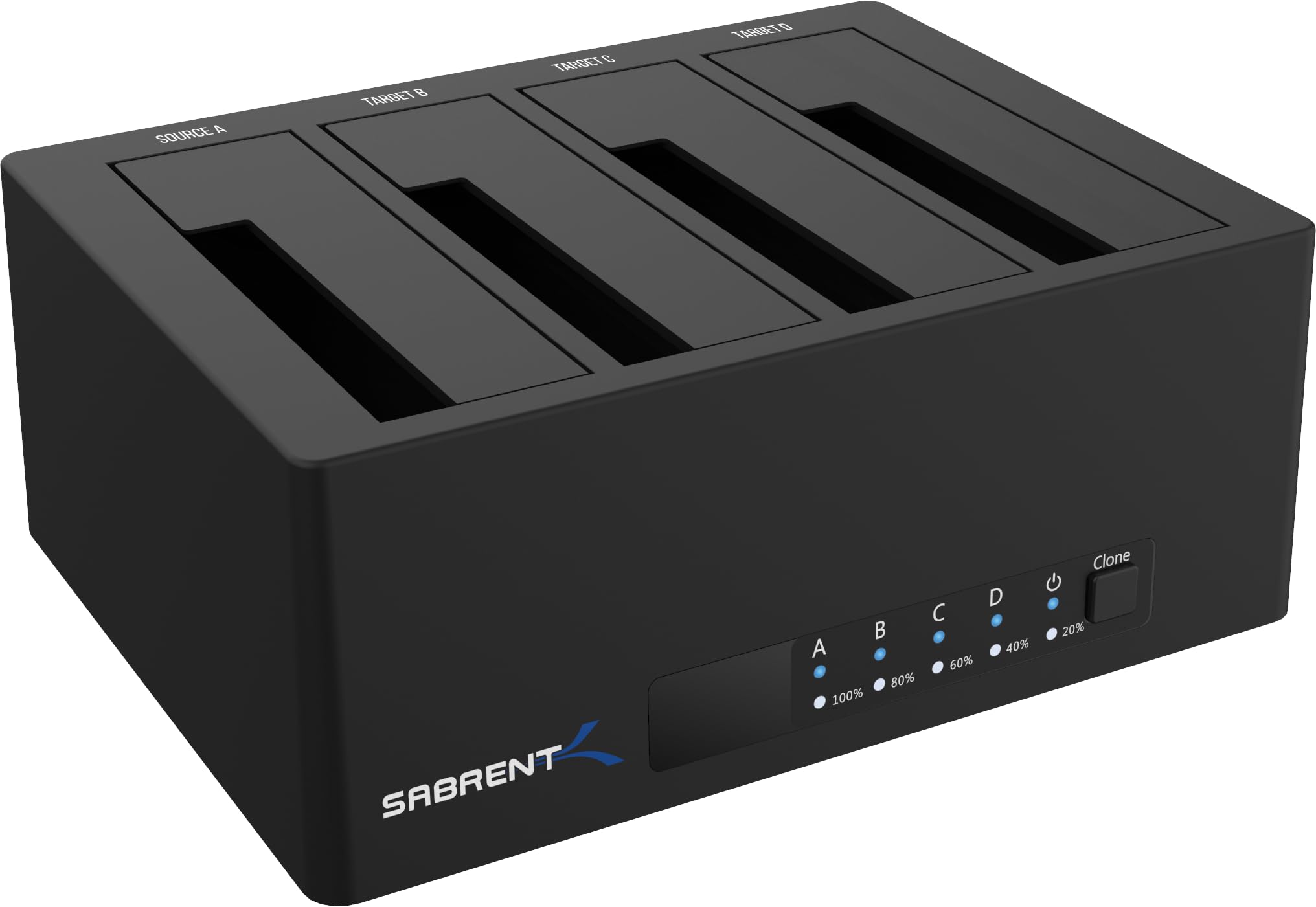
Read Amazon ReviewsSABRENT 4-Bay USB 3.0 Hard Drive Docking Station & Cloner (DS-U3B4)
Choose the four-bay model if you regularly manage several SATA drives at once and want more drive positions. The reviewed two-bay dock is the more focused fit when two drives are enough and USB-C is preferred.
- This dock offers four bays for 2.5- or 3.5-inch SATA HDDs and SSDs, USB 3.0 transfers up to 5Gbps, and offline cloning with progress LEDs.
- The main model has two bays, USB-C, and support for 2.5- and 3.5-inch SATA HDDs.
Hard Drive Docking Stations alternative
17,000+ ratings
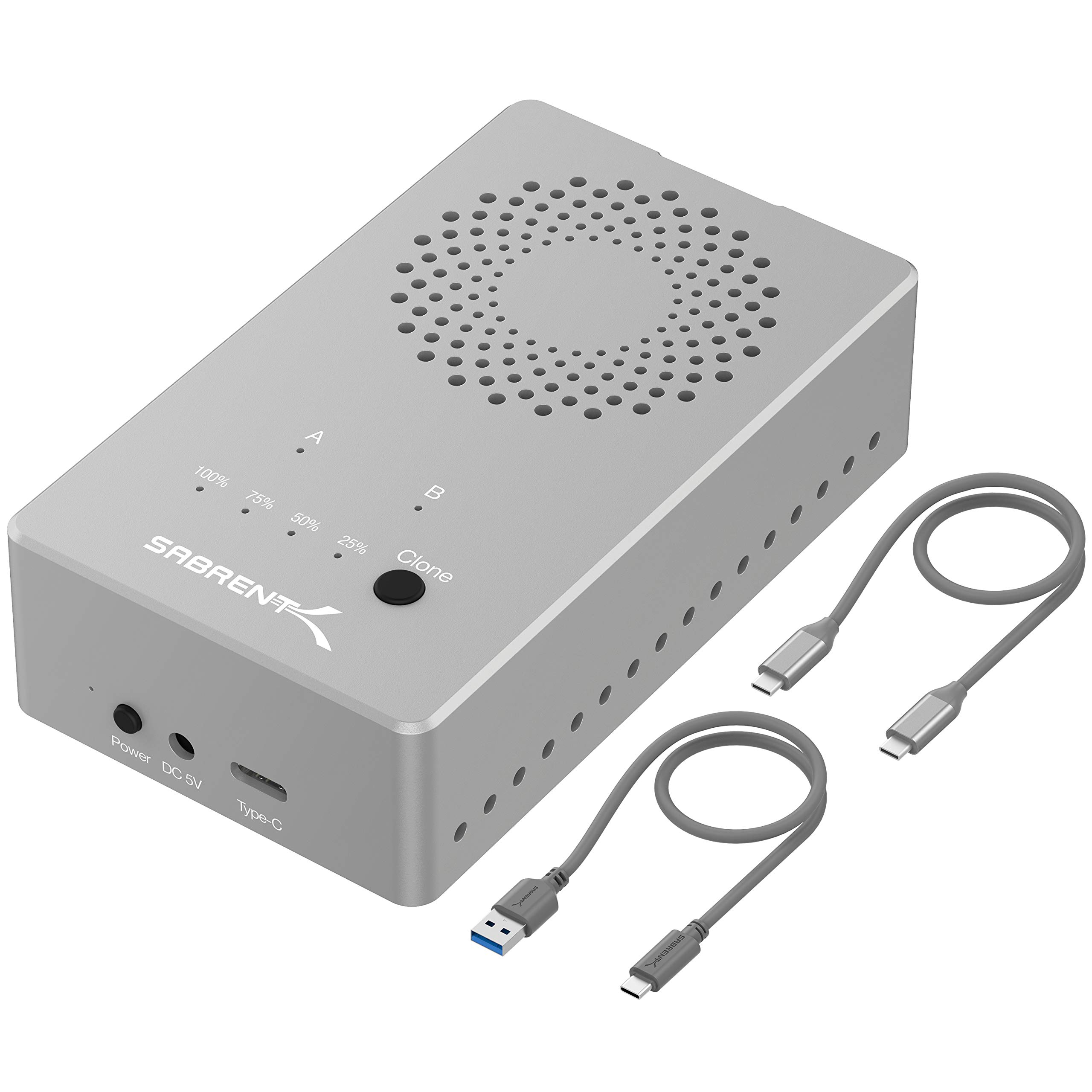
Read Amazon ReviewsSABRENT Dual-Bay USB-C NVMe M.2 SSD Cloner Dock (EC-SSD2)
Choose the NVMe dock if your drives are PCIe NVMe M.2 SSDs and you want a dock made for that format. For the SATA HDD sizes supported by the main model, the NVMe alternative is the wrong fit.
- This two-slot dock is for PCIe NVMe M.2 SSDs in 2230, 2242, 2260, or 2280 sizes, with USB 3.2 speeds up to 10Gbps and offline cloning.
- It is not compatible with M.2 SATA/AHCI SSDs.
- The main model is designed for 2.5- and 3.5-inch SATA HDDs, with USB 3.0 speeds up to 5Gbps.
Is SABRENT Dual-Bay Dock Worth It?
The SABRENT Dual-Bay USB-C Hard Drive Docking Station & Cloner is worth considering if your routine involves two 2.5- or 3.5-inch SATA HDDs and you value both computer-connected access and offline cloning.
Its two-bay flexibility, hot swapping, and tool-free setup make a practical combination for a home drive workflow.
Buy it when those specific functions match your drives and tasks. Keep expectations grounded in the stated speed ceilings, and choose another format-specific solution if your drives are not compatible SATA HDDs.
Your review at a glance
1,000+ ratings
Read Amazon ReviewsSABRENT Dual-Bay USB-C Hard Drive Docking Station & Cloner
A practical fit for buyers who want to access two SATA drives at once or clone between them without a computer.
- Dual-bay design supports reading and writing two hard drives simultaneously when connected to a computer.
- Offline cloning copies directly between drives without requiring a computer; the listed cloning rate is up to 60MBps.
- Compatible with 2.5- and 3.5-inch SATA HDDs.
- USB 3.0 connection supports transfer speeds up to 5Gbps.